
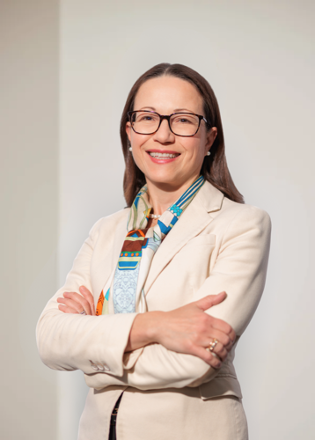
Kate Torchilin, Ph.D., M.B.A., CEO and President, Mirai Bio
Kate Torchilin, Ph.D., M.B.A., is CEO and President of Mirai Bio and a CEO-Partner at Flagship Pioneering, where she leads the company's work as an innovation delivery partner for nucleic acid medicines. Based in Cambridge, Massachusetts, Mirai combines proprietary in vivo data, machine learning, and modular lipid nanoparticle design with CMC and manufacturability expertise to help partners move next-generation genetic medicines toward the clinic, extending delivery beyond the liver and into new cells and tissues.
In this Big4Bio CEO Q&A, Torchilin discusses the delivery bottleneck that inspired Mirai's founding, what differentiates its integrated LNP platform, and the milestone that took a partner program from concept to IND-enabling studies in under ten months. She also reflects on leading within the Flagship Pioneering ecosystem, the culture required to make interdisciplinary science work, and where she sees Mirai — and the broader field of nucleic acid medicine delivery — heading next.
September 28, 2026
Your Story
Q1. What was the defining moment or insight that led you to take the helm of Mirai Bio?
When I looked at the nucleic acid medicine landscape, I saw extraordinary progress in payload innovation and design, but a recurring bottleneck in delivery. Companies across the industry were solving the same problem: how to reach the right tissue or cell, reduce off-target exposure, and build a formulation that could ultimately be manufactured and advanced to the clinic. The insight behind Mirai was that delivery should not be treated as a one-off formulation exercise: it should be an integrated, continuously learning capability that combines chemistry, biology, machine learning, and development science. I joined Mirai because the company has the opportunity to build that capability for the broader industry, turning delivery from a challenge into an advantage for many programs at once, rather than advancing only one internal pipeline.
Q2. In the simplest terms, what does Mirai Bio do, and why does it matter for patients?
Mirai helps nucleic acid medicines reach the cells and tissues where they need to act. These medicines carry genetic instructions that can tell cells to make, silence, edit, or replace something, but their potential depends on delivering those instructions precisely and efficiently. We develop lipid nanoparticle delivery systems designed to reach the right cells while limiting exposure elsewhere. More precise delivery could allow medicines to achieve the desired effect at a lower dose, reducing off-target effects and adverse events while potentially making treatments possible for diseases that are difficult to address with today's delivery approaches.. We work with partners to translate these advances into nucleic acid medicine programs that can move toward the clinic.
The Science & The Strategy
Q3. What is it about your approach that sets Mirai apart from others working in this space?
Mirai is developing next-generation lipid nanoparticles, applying lessons learned from first-generation LNPs to achieve stronger potency, more precise delivery, better safety, and improved manufacturability. What sets us apart is that we don't optimize delivery in isolation. We connect proprietary ionizable lipid chemistry, high-throughput in vivo screening, machine learning, targeted and modular LNP design, payload optimization, and manufacturability in one integrated loop. The platform learns from in vivo performance rather than in vitro proxies, and that data improves each successive design cycle. Because we build with translation and manufacturability in mind from the start, this combination lets us support multiple payload types, cell types, and partner programs in parallel — and move them quickly.
Q4. What has been your most important milestone to date, and what's the next one you're working toward?
Our most important milestone has been showing that the platform can translate from a broad technical concept into differentiated in vivo performance for our partners. Mirai has built a diverse library of proprietary ionizable lipids, demonstrated access to multiple cells and tissues, advanced targeted LNP work into non-human primate studies, and put in place development processes that support progression toward the clinic. We're especially proud of taking a program in T cells from concept to IND-enabling studies in non-human primates in under ten months. This result shows how our approach to LNP development supports translatability and scalability with low risk. The next milestone is converting that foundation into a larger portfolio of partner programs with clear development paths, while continuing to strengthen the data and machine learning flywheel that improves delivery performance across the platform.
Q5. What is the biggest scientific or business challenge you're facing right now, and how are you tackling it?
The central scientific challenge is that delivery is a multidimensional optimization problem, and potency alone isn't enough. A useful delivery system must reach the intended cell, limit off-target exposure, support tolerability, work with the partner's cargo, and remain manufacturable as the program scales. The business challenge is closely related: partners need confidence that strong early data can translate into a practical path to the clinic. We address both by integrating in vivo experimentation, machine learning, chemistry, translational biology, process development, and analytics from the start, so decisions are made against the full product profile rather than one metric at a time.
Q6. What does it mean to design for manufacturability from the beginning?
It means evaluating whether a delivery system like an LNP can be produced, characterized, scaled, transferred, and controlled as a program moves from preclinical work into clinical and GMP stages. We build the process and analytical understanding needed to support translation, scalability, and technology transfer, while relying on external manufacturing partners for GMP production rather than building large manufacturing infrastructure ourselves. This approach helps partners move toward the clinic without discovering late that a promising formulation is impractical to make consistently, or too expensive to manufacture at scale.
Leadership & Ecosystem
Q7. What has surprised you most about being a CEO in life sciences — something you didn't fully appreciate until you were in the role?
What has surprised me most is how much of the CEO role at an early-stage life sciences company is about creating coherence across very different forms of expertise. At a company like Mirai, scientific, technical, commercial, operational, and partnership decisions are tightly connected, and a single formulation choice can affect development timelines, manufacturability, economics, and the value of a partner's program. The CEO's job isn't to have every answer, but to make sure the right questions are being asked, the tradeoffs are explicit, and the organization stays focused on the deliverables that matter most.
Q8. What role does the Boston/Cambridge life sciences ecosystem play in Mirai's growth?
The Boston and Cambridge life sciences ecosystem gives Mirai access to an unusually deep concentration of scientific talent, company builders, investors, service providers, and biotech and pharma partners. It's also a place where expertise in nucleic acid medicines, drug delivery, machine learning, translational biology, and manufacturing intersects quickly. Being part of the Flagship Pioneering ecosystem adds another layer of connectivity, with experience creating and scaling new biotechnology companies, and proximity to the cutting edge of nucleic acid therapeutics. That density is especially valuable for Mirai because our model depends on bringing together, for the benefit of our biotech and pharma partners, capabilities that are often separated across organizations.
Looking Ahead
Q9. Where do you see Mirai in three years, and what will have to go right to get there?
In three years, I expect Mirai to be recognized as a leading delivery partner for nucleic acid medicine companies, helping our partners turn delivery from a challenge into an advantage in their therapeutic programs. I expect many of our partners' programs, using Mirai's LNPs, to have progressed into the clinic, and I expect Mirai to have unlocked delivery to additional cell types and tissues, including holy grails like the CNS, supported by a larger proprietary in vivo dataset and stronger predictive models. To get there, we keep producing differentiated data, be the best possible partner to our biotech and pharma customers, and maintain a culture of innovation and continuous learning.
Q10. What is one thing about the life sciences industry today that you would change if you could and what gives you optimism despite it?
I would change the industry's tendency to keep discovery, delivery, development, and manufacturing decisions separate for too long. Programs can lose years when teams optimize an exciting biological concept without addressing the practical constraints that will determine whether it can become a medicine. I'd like to see more integrated decision-making earlier, including a greater willingness to stop, redirect, or redesign programs when the full evidence doesn't support them. What gives me optimism is that the field now has better tools, richer data, and more cross-disciplinary talent than ever before. Nucleic acid medicines have already shown what's possible, and the next wave will come from solving enabling problems with the same creativity applied to payload biology.
About The Big4Bio CEO Weekly Q&A
Every Monday, Big4Bio spotlights a life sciences CEO from one of our eight coverage regions — Boston, San Francisco Bay Area, San Diego, Philadelphia, New York City, the Capital Region, Los Angeles, and Seattle. Each feature is promoted across all eight Big4Bio daily newsletters, reaching 30,000+ life sciences professionals. CEO participation is complimentary and editorial — every CEO approves the final Q&A before publication.
Are you a life sciences CEO or do you represent one? Contact Big4Bio editor Marie Daghlian at marie@big4bio.com to be considered for an upcoming feature.