
A Decade on the Map: How Big4Bio’s Regions Moved in GEN’s Top 10 Biopharma Clusters, 2016–2026
June 30, 2026
Each year, GEN (Genetic Engineering & Biotechnology News) publishes its A-List of the Top 10 U.S. Biopharma Clusters — a national ranking it has run since 2014. The 2026 edition, authored by Senior Business Editor Alex Philippidis and published June 1, framed the year around three forces: mid-cap acquirers buying their own lab and manufacturing space, an improving capital-raising climate, and the reshoring of drug manufacturing onto U.S. soil.
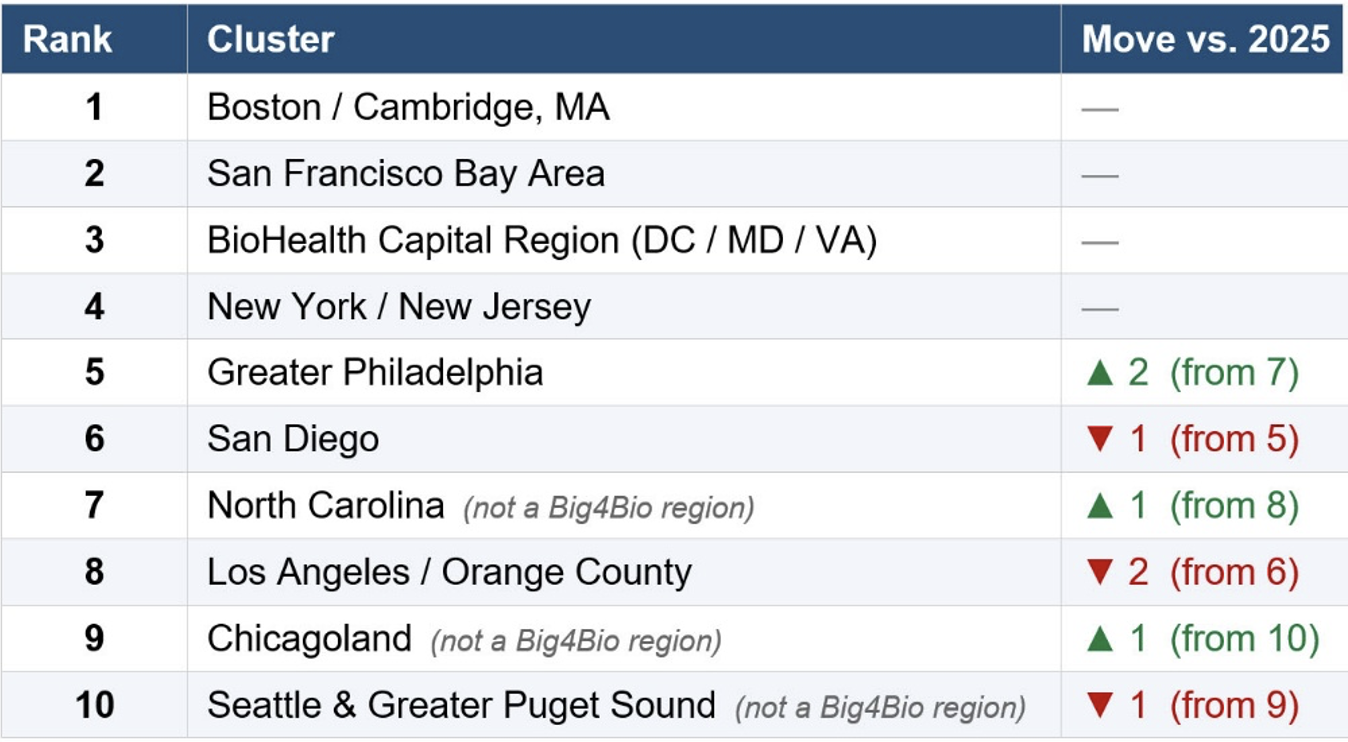
For us, the list doubles as a scoreboard for our own coverage map: eight of GEN’s ten clusters are regions Big4Bio covers every day — Boston, the San Francisco Bay Area, the BioHealth Capital Region (DC/MD/VA), New York/New Jersey, Greater Philadelphia, San Diego, Los Angeles, and Seattle. Only North Carolina and Chicagoland sit outside our footprint. This Spotlight looks past the single-year snapshot to the full decade: how those regions have moved across ten editions of the ranking, from 2016 through 2026, and why.
At the top, 2026 changed almost nothing: the same four clusters that led in 2023 still hold the top four spots, with only Boston and the Bay Area trading the #1 position between them. That stability is itself the story — the upper tier has effectively closed ranks.
The real movement now happens from #5 down, and 2026 delivered its most dramatic in years: Greater Philadelphia vaulted two spots into the top five, the year’s single biggest jump. Read across a full decade, these one-year shuffles resolve into longer arcs — some regions climbing with intent, others drifting. First, a word on how to read the numbers.
How to read the rankings — a note on method
GEN scores each region on five criteria: patents, NIH funding, venture capital, laboratory space, and jobs. A few things make the long view tricky, and they’re worth stating plainly:
- No 2020 edition. GEN skipped a 2020 A-List, publishing in March 2021 instead. The chart connects 2019 directly to 2021.
- The 2023 patent reset. The U.S. Patent and Trademark Office overhauled its public database around 2023, and GEN’s patent-family counts jumped sharply as a result — the BioHealth Capital Region, for example, shows roughly 53,000 “patent families” in 2023 versus about 81,000 in 2026. That reflects a counting change, not real-world growth.
- Rotating sources. Venture-capital figures have been drawn from MoneyTree, then PitchBook and CipherBio, then regional industry groups, across different time windows year to year. Lab-space and jobs figures similarly shift between providers.
Because the underlying numbers aren’t cleanly comparable across the decade, this analysis tracks rank — the one consistent through-line — rather than raw metric values. Every ranking shown is taken directly from GEN’s published edition for that year; none is interpolated.
A Decade of Movement
“GEN’s A-List arose more than a decade ago, when other biotech publications were still wrestling with how to measure the progress of the nation’s largest life-sciences hubs. Since the first list in 2014, it has evolved into a mini history of biotech expansion and growth — and sometimes retrenchment.”
— Alex Philippidis, Senior Business Editor, GEN

What the decade shows: the Big4Bio regions
- Boston vs. San Francisco — the only contest for #1. San Francisco opened GEN’s first list at #1 in 2014; Boston/Cambridge then held the top spot from 2015 through 2022; San Francisco briefly retook it in 2023 on venture capital; and Boston reclaimed it in 2024 and has held it since. No other region has touched the top two in a decade.
- BioHealth Capital Region (DC/MD/VA) — the clearest deliberate climb. The region publicly set a goal of reaching the top three “by 2023.” It sat at #4–#5 through the late 2010s, then hit #3 exactly in 2023 — and has held it four years running, even as federal job cuts at the FDA and NIH weighed on the region.
- New York/New Jersey — quietly steady. A fixture at #3 through 2022, it eased to #4 in 2023 when BHCR passed it, and has been rock-stable there since, anchored by nation-leading NIH funding and two Manhattan mega-campuses (SPARC Kips Bay and Innovation East).
- San Diego — the metronome. Ranked between #4 and #6 in every single edition of the decade, never lower, carried by consistent top-tier venture capital and a multi-campus building boom (RaDD, Pacific Center).
- Greater Philadelphia — the 2026 breakout. It bounced between #6 and #7 for years, then jumped to #5 in 2026 — its best placement of the decade and GEN’s single biggest mover that year — on the strength of reshoring (Lilly’s $3.5B Upper Macungie site) and a venture-capital rebound, atop its cell-and-gene-therapy base.
- Los Angeles / Orange County — the decade’s clearest slide. It climbed as high as #5 in 2023 on the nation’s largest life-sciences workforce, then fell to #8 by 2026 as venture capital and NIH funding lagged. The lesson: jobs alone haven’t defended its rank.
- Seattle — holding the floor. Ranged from #7 down to #10, and has mostly sat at #9–#10 lately. A deep research base (back-to-back Nobel laureates out of UW and ISB) hasn’t offset thin venture-capital and jobs totals.
What it means for the regions we cover
The through-line of the decade is concentration at the top and churn from #5 down. The top four have hardened into a stable order, while positions five through ten reshuffle yearly. And the variable now moving rank is increasingly capital and manufacturing reshoring — not legacy size or headcount, as Los Angeles’ slide despite its jobs lead makes plain.
Industry watchers see the same shift. Sharing this year’s list, Alex Philippidis pointed to a comment from GeneOnline biomedical editor Steven Chung:
“For a long time, discussions about biotech clusters followed a familiar pattern: strong universities, deep scientific talent, venture capital, and a vibrant startup ecosystem. Those fundamentals still matter — but what stood out in this year’s ranking is how prominently manufacturing now features in the story.”
— Steven Chung, Biomedical Editor, GeneOnline
Hat tip to Alex Philippidis and the team at GEN for more than a decade of this franchise. Read the full 2026 A-List here: GEN — Top 10 U.S. Biopharma Clusters 2026