
A Contrarian Investor on What It Takes to Go From A Great Idea to A Scientific Success
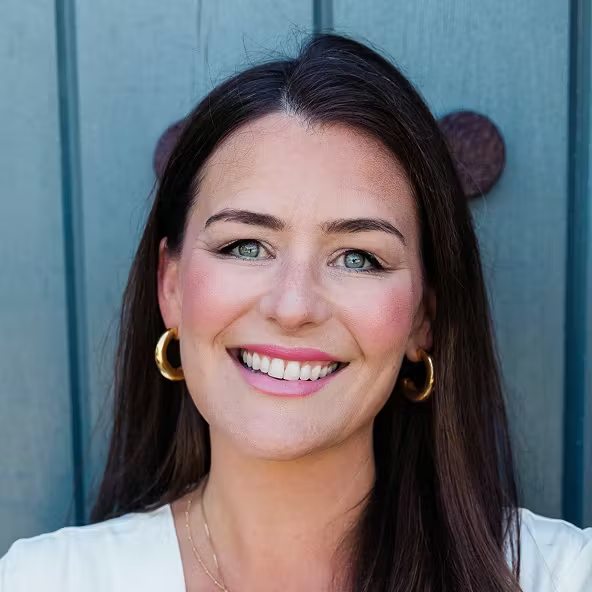
Breakout Ventures Co-Founder and Managing Partner Julia Moore loves helping people move science from a great idea to a life sciences success. After working as an equity analyst, she spent a decade investing in and operating early stage companies before co-founding Breakout Ventures in 2016. Just ahead of the annual JP Morgan Healthcare meetings in early 2026, she sat down to share her insights with Big4Bio Senior Editor Marie Daghlian on what it takes to move a great scientific idea to a commercial success.
January 12, 2026
A Contrarian Investor on What It Takes to Go From A Great Idea to A Scientific Success
Breakout Ventures Co-Founder and Managing Partner Julia Moore loves helping people move science from a great idea to a life sciences success. After working as an equity analyst, she spent a decade investing in and operating early stage companies before co-founding Breakout Ventures in 2016. Just ahead of the annual JP Morgan Healthcare meetings in early 2026, she sat down to share her insights with Big4Bio Senior Editor Marie Daghlian on what it takes to move a great scientific idea to a commercial success.
Marie Daghlian
What led you to starting Breakout Ventures with Lindy Fishbourne? Obviously, you had already been doing some of this kind of work for many years.
Julia Moore
Yeah, I think I'll give a little bit of context. Whenever we think about how we talk about ourselves and differentiation, it's like I wish everyone could just experience us and then they would get us and we don't have to use words. That’s why I’m so glad you were able to come to our ‘Biotech is Dead. Long Live Biotech!’ debate a few months ago. Now you’ve really had a chance to experience Breakout. I'll give you a little bit of the framing that it looks like you've been able to get from my background. I come at this world a little bit differently. Our team, first of all, is a mix of deep technical talent and commercialization and business and finance.
I come from a family of MD's, PhD's. and started on the lab path as an undergrad.
I grew up around MGH in Boston and thought that was my path and soon realized early on that I really loved the business, its speed and the innovation side of things, and moved into public markets and equity research. I didn't know at the time that it's such a great training ground. So being in equity research and in public, you’re sort of taught where the puck's moving, you know what is really valued—where there isn't narrative and there's just hard numbers, what that looks like, and what it takes to get to those kind of exits and IPOs, having worked on a lot of them myself.
But then from there I went right into venture and then into operating and spinning out a company and being that person who's doing the commercial plan and the fundraising and hiring and firing. And I'm very happy on this side of the table. I spent my Christmas laying off a manufacturing team and I have true empathy for what teams go through.
But I think that a lot of starting Breakout Ventures, what was really interesting when I started working with Lindy at Thiel and at Breakout Labs, the attraction there for me was just the non-consensus bold view of not being like what everyone else is doing. I mean at that time it was apps. Everyone was doing an app fund and everything else. But where is there real durable value in the world and how are people thinking about it the wrong way? And it was just so fun to be contrarian every day in that way. And it’s how we built Breakout Labs by saying, OK, if we're going to be contrarian, that means we're going to have to bring in corporates earlier because there may not be as much capital. We're going to have to, you know, get them more resources. We're going to have to build these companies differently. We're not going to assume the next check is there.
I think that has really pushed through in the way that we started Breakout Ventures. We knew that we were on to something—that this was not just a gap we were filling along with other family offices. This was a new space and a redefinition of what life sciences could look like. And so, when we started Breakout Ventures, I joke with other people that it's not too different from the story of a lot of our CEOs and founders. It wasn't like a big decision. It’s the only thing we knew how to do and quite literally we had people asking to give us money. And we had founders asking for money from us and that's how we started Fund 1 together.
Marie Daghlian
So, somebody comes to you with a great idea. What is it that they have to do to attract investment from you? In your website bio you talk about power law potential. What is that?
Julia Moore
Yeah, to get at your question of what attracts venture interest beyond a great idea. Great ideas are table stakes. They're just an idea. You can have an idea and not have execution. The ability to execute a truly great idea that then leads to that power law potential is really a founder or founders who understand how that moment is different. So, whether it is a change in technology that's an unlock, a market dynamic that's an unlock. They understand why there can be a translation of that moment in time for their good idea to move faster, cheaper, and have a higher probability of success. And those market dynamic pieces mean a lot. Every investor should ask the “why now” question.
Take the example of Cytovale, one of our Fund 1 companies, and I looked at sepsis diagnostic deals 20 years ago, a potential gold mine, but every one of them died. CytoVale had a big insight no one was looking at: computer vision is at a point that we could do this in high throughput with microfluidics and analyze the cell morphology and give a disease-state cell signature in minutes. It became the first FDA-cleared sepsis diagnostic to provide rapid detection in the emergency department, is commercial and it raised a $100 million venture round. When I look back about what we saw in them years ago, it was that they were saying, I'm thinking about this problem differently and this is the reason why I can tackle it.
Marie Daghlian
How do you advise your founders? What kind of business models should a company pursue to, you know, do what they want to do as quickly, but also as cost effectively as possible?
Julia Moore
We're of the view that there's no single winning model. The companies that succeed are really aligning their business model tightly with the technical strengths of their technology, their platform, with the reality of their market. They understand the dynamics, they understand where they're delivering value for their customer or partner, and so they know what they can charge in that relationship. I do want to say that in our space, and we saw this in in therapeutics over the last five years, there was a lot of contorting company wise to fit a financing narrative and then the winds changed and they were all kind of stuck holding the bag. So, we try and work with our companies to deeply understand those market dynamics, who the customer is and what your optionality is in all of these things so that you're working with a business model that is best for what you do and that you're taking on dilutive capital to fund what you uniquely do well. So, I think, over the last five years, companies that shouldn't really be drug companies were becoming drug companies because they wanted to own the asset, but they weren't uniquely good at developing drugs and is that what you should be taking on dilutive capital for?
As far as business models that can accelerate development but still contain costs, I often talk about the need to change the math of drug development. It’s an equation. There's cost, there's time, there's probability of success. A lot of what we focus on in our investments is understanding where in that equation our companies are doing things differently—better, faster, and cheaper.
The strongest business models today are built to learn faster, generate value faster. There's been this mentality of owning an asset. It's a drug, it's a device, it's a diagnostic, and I still think that that is in a lot of cases where value accrues, but we're sort of redefining what an asset is. One of our companies, Noetik, just made an announcement that got a lot of attention. They announced a deal with GSK for non-exclusive access to their foundational models, trained on highly differentiated, clinically relevant data. The asset here is the combination of the data, the models, and the ability to keep learning, and that in and of itself now has standalone value. In this case, with $50M up front. We’re seeing more ways for companies with proprietary assets like that to bring in meaningful capital.
It doesn’t always have to be, hey, let's put in hundreds of millions of dollars and 10 years later we have a drug; it's how do we bring in capital early that can help our companies build assets that meaningfully reduce downstream risk. Noetik is only a few years old and just brought in, in a single deal, about as much capital as they’ve raised to date and that gives them tremendous flexibility to compound from here.
We're seeing that ability to generate more options early and what I like about that is that J curve of a drug, you're in there for a long time, right? It costs a lot of money to know that you're wrong when only 10% of drugs that get to an IND, get approved. So, the faster you know if you're right or wrong, it saves our companies a lot of money, but it also saves our partners and customers a lot of money, and we're seeing that translate.
It goes back to the math problem.
The way that we've built things maybe is a little bit different than a therapeutics only firm or those doing company creation, which we don't do. We're very focused on the founder. We're early stage investors but really that just means we want to be with you from the beginning. That can be a $500,000 check or a $6 million check in those early rounds. We lead about half of our deals and are active through to exit. 80% of our companies have some sort of formal corporate relationship within the first funding and I think that speaks to there's no point to build in a vacuum. You're just going to waste time and money. You need feedback loops.
Marie Daghlian
What is the importance of making decisions with intention, weighing the risks and opportunities, looking for the right time to take advantage if an opportunity comes along?
Julia Moore
The way that we think about it is that every start-up is a bet on a future that doesn't exist yet. And the key is really knowing which risks are worth taking and which ones are not. Since we're early stage, we really are conducting due diligence on how these founders think about that last part. We are having a lot of conversations to figure out if they are paying attention, will know when to change their stance on something, will know what new data to look for to help them understand things better. I still spend a lot of time with public investor friends and use them for feedback. I love when seed founders take me up on those intros, it tells me that they're thinking about ‘I don't want to be in my venture bubble’ or ‘my cohort of other founders who are telling me what to do’ or ‘what a venture investor told me to do’; I'm trying to see what the market is feeling, the insights there, and the same with corporates. We'll even make some of those in introductions during diligence and use it as an opportunity to say, “Hey, we've been talking to this BD group about your space. Would you be interested in talking to them? I would love to hear what they think and what you think they're maybe missing.”
When we talk about understanding and being intentional about that risk, I’ve already put the numbers out. If you're talking about therapeutics only, the probability of success is not great. So, you are thinking about how to mitigate those, how to tee yourself up for better outcomes, how to create optionality in your platform with partnerships. Something that we do a lot with our companies is we have a lot more diversity of capital sources, so not just venture and equity. There's obviously partnerships but a lot of our companies also have grant money of different kinds or foundation money. The companies that we really are successful with and lean into are thinking about all of it. They are totally comfortable that they don't have to be the darling of every venture group. They have to be understood by the people who matter. And so, we look for a lot of that and we do diligence on a lot of those points early.
Marie Daghlian
OK, it sounds like the attitude of the founders plays a big part on your decisions to invest besides the platform or their ideas.
Julia Moore
Yeah, it's both. We're lucky that we're in a space where you can get both. You can get really innovative unlocks with technology and really talented founders. It's all about founders. And honestly, I don't know that that's always been at least my tone, but I’m not sure I’ve ever had a failure because of “science”. It always seems to come down to people.
Marie Daghlian
It's pretty amazing after heavy doldrums for a year and a half that biotech is now starting to take off. Some companies are still having trouble raising capital, but there are a lot of great tailwinds, especially in the adoption of AI, and pharma dealmaking has ramped up in the final quarter of 2025. So, what do you think about the general state of the industry and where it's heading?
Julia Moore
Yeah. I'll talk about how's the market feeling and then maybe another layer of how AI plays into that and our version there. It's interesting because I think it does feel that this industry has really become like a ‘haves and have nots’ type of market. And the insight that I might have about that is that the downturns of the last few years really tended to punish companies that were built for a specific moment in time in the market and not for durability. And the reality is we're in an industry where the development of every drug is going to be through multiple administrations and IPO windows and cycles. I mean these are long term, so when you don't build for that duration, that's who really suffers in the downturns. A downturn doesn't really punish strong science that is paired carefully with company building. It punishes when you went and raised the $300 million and you had nothing and now the bar moved during that period,
I'll go into research mode, obviously in Q4 a calming around interest rate expectations helped. When your cash flows are still pretty far out, that has a big impact. In this case positive, but as we learned a few years ago watching the XBI, we can get hit pretty hard too.
Now we are coming out of a period of tight budgets though across the industry. Everyone sort of starved their pipelines to get through that period and now has to rebuild them. There has obviously been some huge deals on how do we get accretive commercial programs right away. But we are excited about what we think will happen to build pipeline from there. We're probably going to get the best return on the things we built lean these last few years – the next, next gen. Maybe pharma built the first gen, they spent $2 billion on the next gen to fill the holes, and now they're worrying about the wave after that, and that's really what a lot of our portfolio today is building for.
There's a lot of interest from corporates when you have something different. Because they are trying to build and differentiate their pipelines. From our perspective as investors, it is a great market for adopting innovation too. You’ve gone through a tough cycle and we’re moving to the other side of it but big companies are scrambling to catch up. That’s when adoption is accelerated, right? Because they already took their hits. There’s no easy money or status quo that they're worried about disrupting. Now they're like, hey, if we're going to survive, what do we need to do differently? They've taken care of their balance sheet to make sure that things are OK and now they can kind of invest in the future again. I'd say the market feels good from that perspective. I'm not speaking to the investor landscape as much as I'm speaking to the industry. We focus so much on whether we are we building something that someone wants. But the early stage funding definitely feels like it's more stable again as well. Early last year, it was like what are we doing here? It was just a confusing time.
Now to bring it back to your question on AI, a lot of our excitement has been how AI is really becoming this foundational infrastructure across life sciences. The real precedent isn't so much who uses A I but where are you creating durable advantage and meaningfully changing outcomes. Where can you get validation faster? Where can you increase probability of success? Where can you bring down costs? And I think that that is no longer experimental. This isn't about, hey, we're going to see how we can use AI. It's really becoming layer of strategy within pharma and within every new company that starts. And one of my favorite sayings is “AI won’t replace drug developers, but those who use it will replace those who don’t”. It just becomes part of the table stakes for building something quickly and competitive now.
What I'm really interested in is when we start improving that 10% success rate from IND to approval. Like what do we think it looks like 10 years from now? How does that change the math? How does that change how we underwrite things? How does that change what you bring into preclinical and what you spend money on?
Not having to do animal models and being able to do it computationally changes a lot about the industry. There was this chart last year where all of Big Pharma fit in the market cap of NVIDIA. And that was crushing to our industry. And you could look at that as our industry is left in the dust or you could look at it as the AI infrastructure was just built and what industry has the biggest opportunity to benefit. What industries get that second and third derivative—those with proprietary data, right, and some sort of durable advantage. So, what we have is tons of unmined proprietary data as an industry. You don't have the same threats of being irrelevant quickly that I think a lot of other industries are struggling with. AI it can be a real durable advantage for us.
And pretty quickly, it’s changing everything. I mean, a year ago, Noetik was steadily compounding progress out of the spotlight. But their foundational model already knew more than any single human could about the underlying biology of cancer. I was waiting for everyone to understand how big a deal that was, how big a deal it was that our industry now had access to things like unsupervised learning and self-supervised learning. These approaches are a huge unlock, and they are different from how other industries talk about AI. They're starting with zeros and ones that are already labeled. We're starting with cells. It's a ton of data, but none of it comes pre-labeled. The real breakthrough has been making that biological data legible and structured enough for machine learning.
Marie Daghlian
Do you have any predictions for the year ahead?
Julia Moore
JP Morgan is such a good time to get a little bit more of the sentiment of the industry and a sense of what people are working on this year, how they're changing. I think what we're seeing a lot right now, and so maybe a prediction that I was not prepared for, is you're finally going to see an inflection point in sustainable deal structures that link AI infrastructure and pharma through the data itself. Not one of those ones that everyone looks at and is like, oh, you'd never get that again, that's a one-time thing. I think a lot of those early AI discovery deals got dismissed that way. But in our own portfolio we're seeing real templates now for how to do a deal. There was no template for the Noetik deal so they actually had to talk about what value are we delivering. Maybe 2026 will be a real inflection point for new deal models.
Marie Daghlian
Great. Thank you so much for your time. This was very informative and I love your enthusiasm for what you do and your insight on how a founder can succeed and commercialize its scientific vision.
Julia Moore
Thanks, I enjoyed the conversation.