
When Drug Development Becomes Personal: Meg Gill’s Mission to Find a Treatment for Her Daughter
At Charles River’s 30th Annual Biotech Symposium in San Diego, Meg Gill shared a story that went far beyond the science of drug development.
By Kari Bennett and Marie Daghlian for Big4Bio
September 17, 2026
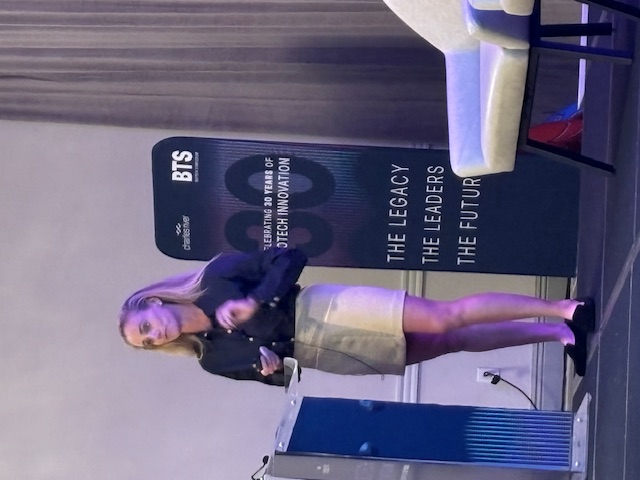
Meg Gill started Golden Road Brewing when she was 25, sold it to Anheuser-Busch at 30, stayed through three consecutive earnouts, and spent a decade running a portfolio of high-growth brands for the company.
Then her daughter GG was diagnosed with an ultra-rare genetic disorder, and she left the industry entirely.
With no approved treatment and no established roadmap for developing one, Gill decided to build that roadmap herself.
“It is God’s irony,” she told the room at Charles River’s 30th Annual Biotech Symposium in San Diego, “that now I’m doing an N-of-1 and its just for my kid.”
Charles River’s 30th edition of its Biotech Symposium was held this week at the San Diego Mission Bay Resort, bringing together scientists, toxicologists, regulatory specialists, drug development professionals, and thought leaders to advance biotherapeutic innovation.
The symposium focuses on unpublished preclinical work in progress, and is highly valued as it provides an interactive setting over three days for discussions among scientists working at the forefront of therapeutics. A highlight of the symposium, the “Think and Drink” session, encourages creative problem solving.
Much of what gets discussed there does not travel far beyond the room: nonclinical development stories are among the hardest for companies to clear for public discussion, which is part of what makes the event useful to the people who attend it.
The Symposium extended Big4Bio access to Monday’s session, where Meg Gill, now founder of the Sweet Geej Foundation, described building an accelerated, single-patient drug-development program for her seven-year-old daughter. Ten months on from diagnosis, the program has a lead candidate, a validated patient mutation model, a completed FDA pre-IND interaction, and its first Charles River study beginning the following day.
Gill’s daughter GG had just turned seven. The diagnostic journey took almost exactly that long. Early assessments pointed in several directions, including non-speaking autism, without ever landing on a single gene. It was not until a neurologist in Arizona ran whole genome sequencing that the family got an answer: a variant in NAA15, an ultra-rare neurodevelopmental disorder with roughly 65 cases in the published literature.
Gill received the diagnosis on October 15 of last year. She emailed a researcher the same day.
She had found his name on a Facebook page run by the Simons Searchlight patient group — written on a Post-it note that was visible in the background of a photograph someone had taken in a lab. She wrote to him that afternoon. The researcher, Dr. Gholson Lyon, gave her a Zoom meeting.
At that point she did not know what an antisense oligonucleotide was. “I’d never heard of it,” she said. “I didn’t know where the industry was in gene therapy. But I just felt like if there was one thing we could look at correcting, it was worth me going on the journey.”
Ten months later, the program has a protein-active lead candidate, a validated patient mutation model, and a completed pre-IND interaction with the FDA that Gill describes as drawing a very positive response. The approach is mutation-agnostic by design and is intended to treat GG as quickly and as safely possible, and then to help other NAA15 families.
But as Gill made clear during her presentation, the science is only part of the story. The other part is the network of people who have stepped forward to help.
A room full of people who could help
Gill’s presentation, “The Single-Patient Sprint: When 18 Months is Both a Sprint and a First-Ever Channel Crossing,” was delivered to an audience of scientists and drug development professionals who understand exactly how difficult the journey she described can be.
Her message to them was surprisingly simple.
“Coming from a corporate background, I understand the KPIs, the nine-to-five jobs, the administrative work and all of the priorities that scientists have,” Gill said following her presentation. “I just hoped that GG’s story could inspire them to think, ‘We can take the technology we have right now and actually help cure kids faster.’”
For Gill, that means looking at the work differently. “How can I turn things around a little quicker?” she asked. “How can I be a little more inspired by my job because I know it might be helping a mom, a family or some kids out there?”
It is a perspective that resonated particularly strongly in a room filled with people who spend their careers working through the complexities of nonclinical development, toxicology, regulatory strategy, and clinical research.
When a CRO becomes a partner
Charles River entered Gill’s journey during drug discovery, before any commercial relationship existed and goes beyond a traditional client-CRO engagement.
“They walked me through what safety needed to look like with the FDA before I had ever signed a scope of work or paid them a dollar,” Gill said. “They actually sat in my pre-IND meeting and talked to the FDA with me. That’s amazing.”
The relationship has continued past the boundaries of any single study. Gill said she regularly asks Charles River’s Dr. Lauren Black and Dr. Michael Templin about pharmacology outside the work they are formally engaged on, and gets answers. “They respond right away. They understand how quickly I’m trying to move, and help me sort through candidates and the lead-selection process.”
Early tolerability work with a local San Diego CRO surfaced acute toxicity in one candidate. The chemistry has changed: the backbone is now mixed, closer to what larger developers are using and results on the leading efficacy candidates came back positive.
“When Dr. Black first told me, ‘I’m adopting GG. You’re in good hands,’ that was the moment I realized something was likely going to happen for her,” Gill said. “If I ran out of candidates and needed to go back to the drawing board, I believe they’re going to be there long term, and we’ll find something that can help her,” she said.
Hope is part of the science
For a family that spent years without an answer, the progress has already changed the emotional landscape. “It’s given all of us hope,” Gill said. “Our whole family is energized every day.”
She also described changes in GG herself, including improvements in her ability to spell, communicate and regulate. “Everything has improved through this partnership, the hope that we have and just the process,” Gill said.
In GG’s case, the journey is still unfolding. The program is mid-flight, and significant scientific, regulatory and clinical hurdles remain. It is also a reminder that behind every drug development program are people: patients and families, researchers, clinicians, CRO teams, regulatory experts and countless others whose contributions may never appear in a scientific abstract.
The San Diego connection
The family lives in Orange County, but much of the network that made this possible is in San Diego.
Gill read about Dr. Olivia Kim-McManus, a neurologist at Rady Children’s Hospital and got GG in to see her quickly for a Brain Study, and also connected with the Rady Institute for Genomic Medicine and Dr. Kristen Wigby. Once the diagnosis was confirmed, the hospital routed the family through every relevant specialty department.
“We had been to a lot of places, and we hadn’t felt support like this until we found the San Diego network,” she said.
She sees a connection between the region’s hospital system and its biotech density. “Maybe that’s part of why there’s also such an amazing biotech community here,” she said, pointing to the UC San Diego framework and the region’s startup culture, a network that has since connected her with collaborators, including her research Principal Investigator, Dr. Michelle Mattson-Hoss.
The Long Road Ahead
Gill did not present a finished success story. The drug-development program remains in motion, and significant scientific, regulatory and clinical hurdles remain. But that is precisely why she wanted to share the story with the people in the room.
Her goal was not simply to tell them what had been accomplished. It was to show them what a single-patient drug-development effort actually looks like from the inside, and to invite the broader scientific community to consider how its expertise might help make the next one move faster.
Her daughter’s brain is developing now. That is the reason the sprint is a sprint.
Charles River, a global contract research organization (CRO), is dedicated to helping researchers and companies accelerate biopharmaceutical drug discovery, research, nonclinical development, and safe drug manufacturing.